
Nigerian Deliberative Town Halls: 2026
In summer 2026, IDEA returned to Nigeria for a second round of Deliberative Town Halls (DTHs), this time in three federal constituencies. Citizens in Bende met with Hon. Benjamin Kalu on June 20, citizens in Obio-Akpor met with Hon. Chinda on July 11, and citizens in Ikole/Oye met with Hon. Rotimi on July 18. In total, 678 citizens attended, and 2,014 took part in pre- and post-event surveys.
The three constituencies span different regions and languages. Bende is a rural constituency in the largely Igbo-speaking Southeast, Obio-Akpor is an urban constituency in Port Harcourt in the Niger Delta, and Ikole/Oye is a largely agricultural, Yoruba-speaking constituency in the Southwest.
IDEA Fellow Marco Castradori, a PhD candidate at Princeton University, led the study. Before the DTHs, he spent the autumn and winter of 2025 in Nigeria interviewing more than thirty sitting members of the House of Representatives, and he worked with three Nigerian research assistants to interview 120 citizens in English, Hausa, Igbo and Yoruba. He chose the three participating MPs during that fieldwork.
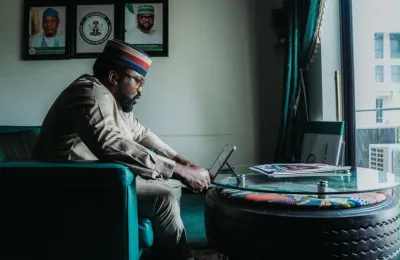
The interviews showed how much Nigerian politics revolves around “delivery,” the material things a representative brings home, such as water, electricity, roads and buildings. Castradori calls this “the deliverism trap.” Citizens judge representatives by what they can see, so MPs spend their time meeting individual requests instead of working on longer-term policy. The 2026 study tested whether a structured encounter with an MP could change how citizens judge their representative, even when the MP delivers no project or personal benefit.
How the town halls worked
Because few constituents have reliable internet access, participants in each constituency gathered in five local venues, equipped and staffed by the research team, while their MP joined live by video from Abuja. Participants worked out their questions among themselves, and research staff wrote them down and passed them to the MP one at a time. Each session lasted between 62 and 76 minutes, and afterward participants at each venue discussed the event in focus groups.
Invitations were assigned at random. In each constituency, the team selected 80 small census areas and randomly chose which areas would receive invitations. Enumerators from NOIPolls, a Nigerian polling firm, surveyed residents and delivered the invitations in person, and participants received about $5 to cover their travel. Across the three constituencies, 62.5 percent of those invited attended, compared with about 37 percent at similar town halls with members of the U.S. Congress.
What the research found
Compared with residents who were not invited, those invited to a DTH rated their MP more favorably and felt more strongly that people like them are listened to and taken seriously. They also reported more trust in elected officials, greater satisfaction with democracy, and more hope that democracy and government can improve.
The DTHs also helped citizens form views of their MP in the first place. Invited residents were less likely to say they did not know enough to judge their MP. In Obio-Akpor, the average number of questions about the MP that residents could answer rose from four out of eight before the DTH to more than six afterward.
The effects were strongest in Ikole/Oye and Obio-Akpor and close to zero in Bende. In all three constituencies, the DTHs did not change the priority citizens place on immediate local delivery compared with lawmaking and longer-term work.
“We find some pretty positive improvements in trust in elected officials, satisfaction with democracy,” Castradori said. “But what we don’t find is any real change in what people want their MPs to pursue.”
Attendees reported very positive experiences. In all three constituencies, attendees were more satisfied with their MP after the DTH than before, said they were more likely to vote for him, and rated his qualities more highly on almost every question asked. Men and women attended in nearly equal numbers in Bende and Obio-Akpor; women made up 57.5 percent of participants in Ikole/Oye, and participants in Obio-Akpor were mostly young.
A separate experiment in the follow-up survey asked residents to judge a fictional MP. Descriptions of his legislative work and of his respectful engagement with constituents each improved how residents rated him, even though he delivered no project in any version.
What participants said
“Before, I thought he was not working, but with what I saw today, I can see that he is really working,” said one participant in Ikole/Oye.
“I think for him to be able to participate in this kind of thing, that means he values us,” said a participant in Obio-Akpor. “He values the masses. He values our opinions.”
“Today, we are not carrying [a] bag of rice, and he didn’t give us money, but we are satisfied with what he told us,” said a participant in Bende.
What the lawmakers made of it
All three MPs said they would take part in a DTH again. Joining by video spared them the time, cost, and security planning a constituency visit requires, and let each of them speak with more than 200 constituents in an afternoon. The Deputy Speaker of the House of Representatives has since raised the idea of running DTHs nationally, and IDEA is in discussions with the office and seeking funding partners to support that effort.
Why repetition matters
The follow-up survey took place 5 to 10 days after each DTH, so the study cannot say whether the effects last. Castradori describes the project as a proof of concept, and participants often tied their optimism to the practice continuing.
“It would be plausible for people to change some of their priorities if they had evidence that these things were more regular and repeated rather than a one-off,” Castradori said.
“What he did now is what is expected of him all the time, so that people will not feel he is doing it to win the people’s hearts because of the upcoming elections,” said one participant in Bende.
Reports and further reading
Escaping the Deliverism Trap: Recognition and Representation in Nigerian Democracy, Marco Castradori’s working paper on the 2026 DTHs.
What Nigerians want from their lawmakers: The deliverism trap and how to escape it, IDEA’s news story on the 2026 DTHs.
Has Change Begun Already? Latent Demand for Democratic Reform Among Nigerian Citizens, by Marco Castradori, William Minozzi and Michael Neblo, on IDEA’s first Nigerian project.