A summer inside a congressional office
After the fellowship
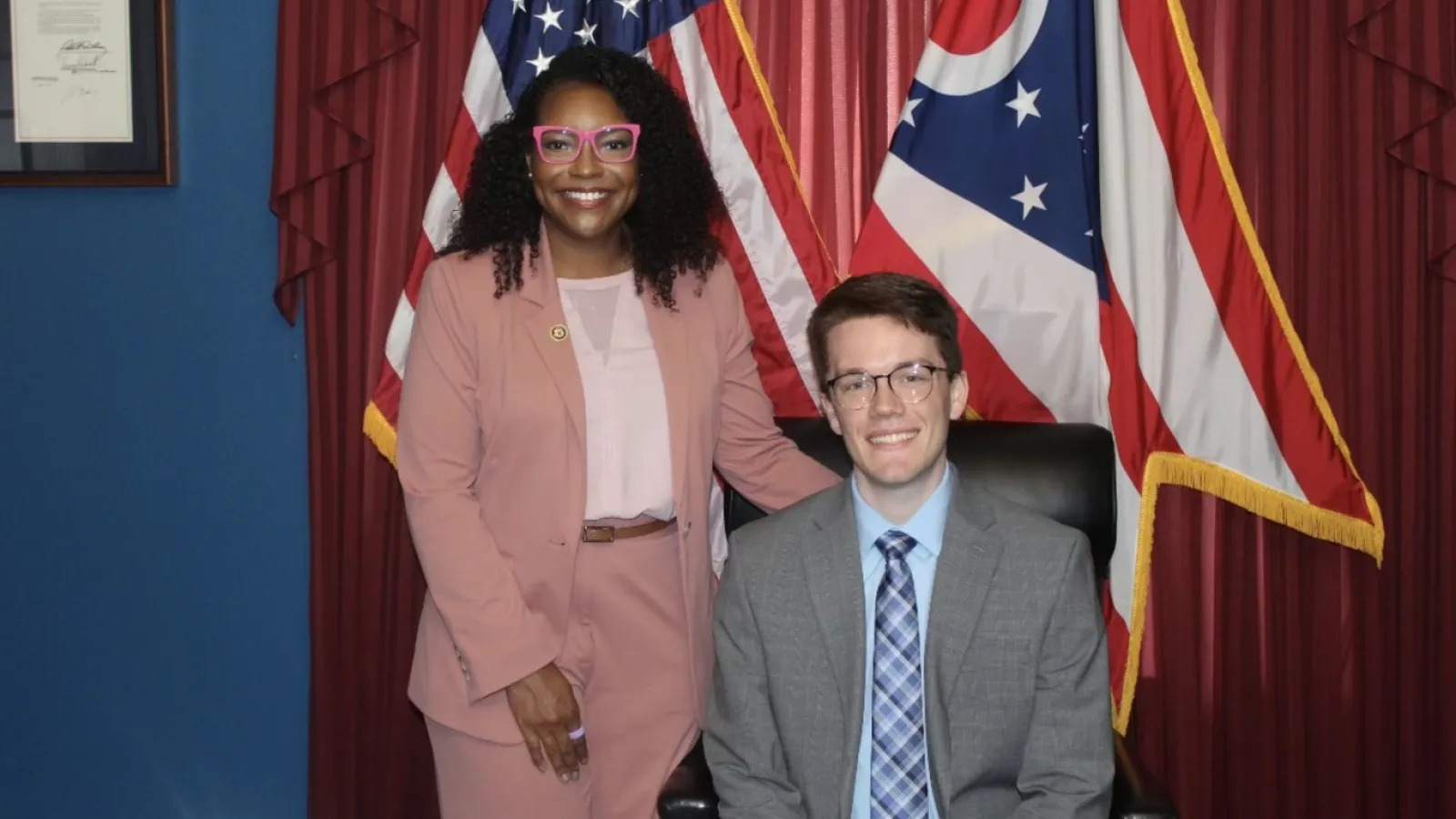
Ryan Mahoney, pictured on the right with Rep. Emilia Sykes, spent his summer as an IDEA Summer Democracy Fellow in her Washington, D.C., office, where he worked alongside legislative staff and gained firsthand insight into how a congressional office serves its constituents.
For Ryan, the moment the experience became real was a quiet one.
“I heard my Legislative Director mention that the Congresswoman had decided to cosponsor a piece of legislation that I had written a memo on.”
Ryan had written several cosponsor memos during the summer, but this one stood out. The decision had not been obvious. He had been asked to prepare the memo after a back-and-forth with his Legislative Director, who was uncertain whether the Congresswoman would ultimately cosponsor the bill.
Hearing that she had decided to sign on showed Ryan that the work he was doing as a fellow was not simply an academic exercise. His research and writing contributed to the daily legislative work of a congressional office.
“While I had written multiple cosponsor memos at the request of our legislative staff, hearing that the Congresswoman would cosponsor this bill made it click for me that I was really involved in the work,” he said.
Seeing the legislative process from the inside
Working in Congress also gave Ryan a much clearer understanding of how legislation moves from an issue or idea into the work of an office.
Through training and conversations with legislative staff, he learned more about the rules and procedures surrounding legislation and the resources congressional offices rely on for policy research.
He also saw how offices work with nonpartisan institutions such as the Congressional Research Service to better understand complex issues and support the development of legislation.
For Ryan, who studied politics and democracy as an undergraduate, the fellowship offered something the classroom could not: the opportunity to see representative government in action from inside the institution itself.
“My experience working in a Congressional office this summer is closely connected to my studies as it gave me a better understanding of how representative offices work and how they view their work and their relationship with their constituents,” he said.
A commitment to constituents
Ryan had limited one-on-one interaction with Rep. Sykes beyond a brief meeting with the office’s interns, but his experience with her staff gave him a strong impression of the expectations she set for the office.
Staff members regularly emphasized the Congresswoman’s commitment to her constituents and the importance of producing high-quality work in order to fulfill that responsibility.
That experience shaped the way Ryan thought about the relationship between elected officials and the people they represent.
“Working in a Congressional office absolutely changed how I see the relationship between citizens and their Representatives,” he said. “It allowed me to view how Congressional offices interact with and work for constituents from the office’s perspective.”
He also came away with a better understanding of how much that relationship can depend on the individual representative and the culture of the office culture.

The experience connects directly to questions at the center of IDEA’s work: how representatives understand the people they serve, how citizens interact with their elected officials, and how those relationships can strengthen democratic representation.
Learning to make connections
Not every part of the fellowship came naturally.
As part of the program, Ryan was expected to network with professionals both on and off Capitol Hill. He saw the value in building those relationships, particularly while spending a summer in Washington, but acknowledged that networking was also one of the more challenging parts of the experience.
“I am not a great networker,” he said.
Rather than avoid the challenge, Ryan asked staff members in his office how they approached networking with other congressional professionals. He also used staff directories, events, and other opportunities available to him as a congressional intern.
Those resources helped him become more comfortable reaching out to people and ultimately allowed him to make stronger professional and personal connections during his time in Washington.
Bringing the experience back to the classroom
Ryan’s summer also changed the way he thinks about the subjects he studies. As an undergraduate, he has taken numerous courses examining politics and democracy. Working inside a congressional office gave those ideas a different dimension.
Instead of studying representative institutions only from the outside, he observed how an office understands its responsibilities, communicates internally, researches policy, and responds to constituents' needs of constituents.
That perspective, he said, gave him a deeper understanding of both Congress and the relationship between citizens and their representatives.
For students considering the IDEA Summer Democracy Fellows program, Ryan’s advice is simple.
“They absolutely should apply, especially if they are interested in learning more about our government or if they want to make connections in DC.”
He sees the fellowship as an opportunity not only for students to gain experience in the nation’s capital, but also to contribute to work that supports IDEA’s mission, congressional offices, and the communities those offices represent.
Looking back, Ryan described the summer as:
“An unforgettable and enriching experience that allowed me to forge personal and professional connections, better understand our government, and assist the important work of a Representative from my state.”
Applications for the 2027 IDEA Summer Democracy Fellows open in the spring.