What Nigerians want from their lawmakers: The deliverism trap and how to escape it
In summer 2026, Marco Castradori ran three Deliberative Town Halls in Nigeria to test whether lawmakers can earn trust without handing out goods. His findings suggest that listening and explaining can build trust, even when nothing is delivered.
When Princeton PhD candidate Marco Castradori conducted the first round of Deliberative Town Halls (DTHs) based on the IDEA model in Nigeria in 2024, he and the team at IDEA were excited to learn that the model could be adapted to low-literacy, low-internet-access countries, and that the DTHs produced effects similar to those in Global North countries and more established democracies: increased trust in participating elected officials and support for democratic reforms and modernization. Castradori and IDEA wanted to go back as soon as possible to dig deeper into exactly what the impacts of DTHs are, both for elected officials and citizens. This summer, he did, and the preliminary results are now available as an IDEA working paper, Escaping the Deliverism Trap: Recognition and Representation in Nigerian Democracy.
The deliverism trap
Before going straight back into conducting the new series of DTHs, Castradori wanted to understand the political environment of Nigeria more rigorously, so he spent the autumn and winter of 2025 in Nigeria, interviewing more than thirty sitting members of the House of Representatives about their experiences with constituent engagement. To hear from citizens, he worked with three Nigerian research assistants to conduct open-ended interviews with 120 people in English and in Nigeria’s three largest languages, Hausa, Igbo and Yoruba.
The main theme he heard from elected officials was the tension between developing and advancing robust national policies and serving an overwhelming number of individual requests from constituents.
“You’ve got everyday thousands of people who need help,” Castradori said. “It’s this tension between solving the immediate problem and receiving a thousand calls every day about, oh, you need to pay the school fees of this child or pay the hospital bill of this mother who’s given birth.”
In Nigerian politics, “delivery” means the material things a representative brings home: water, electricity, roads, buildings. It has become the main evidence citizens have that their representative is working for them, and that is what turns a heavy workload into a trap. A citizen in Bende said, about a building his representative had put up, “Our people say seeing is believing. At least in Ugwueke, we have a hall that he built for us to indicate that he loves us.”
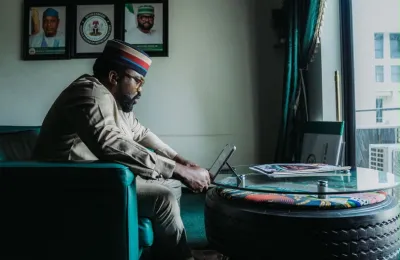
Nobody in Ugwueke can see a committee session in Abuja. A representative can spend a year there debating bills, sitting on committees, and questioning ministers, and none of it reaches home.
So when representatives fail to deliver, constituents rarely blame a lack of money or power and instead take it as proof that the representative does not care about them. “Only God knows what is in [their] hearts and [their] intentions,” one woman said, “and we cannot differentiate between them.”
One member told Castradori that when a bill comes before him, he judges it less by whether it is good law than by what it might bring his own constituency. “Ordinarily I should concentrate on bills; I should concentrate on ensuring that dividends of democracy get down to the Nigerian people. But because of the constant demands back home, when I look at the law, I may not look at them holistically. Rather, I look at it more from the perspective of how it allows me to bring [funding] to my people. And you know I’m supposed to be a federal legislator.”
“I think of it as playing whack-a-mole politics,” Castradori said. “They’re just constantly trying to put out fires wherever they pop up.”
Moreover, members cannot meet the demand. The fund they control for local projects covers “just 1% of whatever it is that constituents need,” one member told Castradori. So a representative can work at it for a whole term and still look, to almost everyone who voted for him, like he did nothing.
This is what Castradori calls “the deliverism trap.” “To deliver is to constantly bring things back home, and that’s the overwhelming orientation that politicians have, and citizens have as well,” he said. “By trying to fulfill short-term needs, you’re neglecting the possibility of solving longer-term ones, and so you’re kind of stuck in this cycle where you can never really break out of it.”
Another way to judge a representative
Here Castradori saw a chance to test whether the IDEA DTH model could provide an alternative way for representatives to earn their constituents’ trust, while focusing on larger policy issues rather than individual constituent problems. “Are there other ways to reassure citizens, at least in the short to medium run, that things that are being done in their name are being done in their interest?” Castradori said.
So Castradori, in collaboration with NOIPolls, conducted three DTHs in Bende, Obio-Akpor, and Ikole/Oye in June and July. NOIPolls surveyed 2,014 citizens before the DTHs to determine their level of knowledge about and trust in their representatives. Invitations were assigned randomly, with just over 60 percent of those invited actually attending. Participants gathered in local halls with internet access, staffed and equipped by the research team, while their representative joined by video from the National Assembly in Abuja. Participants worked out their questions among themselves, staff wrote them down, and the team put them to the member one at a time. Everyone surveyed, whether invited or not, answered the same questions again after the event.
What changed, and what did not
After the DTH, invited constituents rated their representatives higher on character, competence, and effort, and came away with a stronger sense of political standing compared with those who were not invited. Trust in elected officials also rose among participants. Together, these outcomes suggest that delivery is not the only mechanism by which members can earn their constituents’ trust and approval. As one participant in Bende put it, “Today, we are not carrying [a] bag of rice, and he didn’t give us money, but we are satisfied with what he told us.”
What did not change was participants’ views on whether a representative should concentrate on helping with immediate local needs, or on lawmaking and longer-term work. Invited constituents answered after the DTH exactly as they had before it.
“We find some pretty positive improvements in trust in elected officials, satisfaction with democracy,” Castradori said. “But what we don’t find is any real change in what people want their MPs to pursue.”
Castradori said this makes sense. “It would be plausible for people to change some of their priorities if they had evidence that these things were more regular and repeated rather than a one-off,” he said.
A participant said a DTH “will make the people you are representing know your heart,” but only if it keeps happening. “What he did now is what is expected of him all the time,” he said, “so that people will not feel he is doing it to win the people’s hearts because of the upcoming elections.”
What the lawmakers made of it
All three representatives said they would do it again, noting the videoconference format was very helpful. Traveling to a constituency in Nigeria takes time, money and security planning, and a visit brings with it social obligations that no member can easily decline. Joining from Abuja let them face more than 200 constituents in an afternoon without any of that.
Interest has also gone further up the chamber. The Deputy Speaker of the House of Representatives, the second-most senior officer in the chamber, raised the idea of running DTHs on a national scale. IDEA is in discussions with the office about the potential for scaling and is currently seeking funding partners to support such an effort.
Meanwhile, Castradori’s next step is to write his dissertation about this series of Deliberative Town Halls. This is never an easy task, but hopefully his personal interest in Nigeria, which began when he lived there before graduate school, and the potentially important findings will make it as pleasant as possible. “But we hope it doesn’t take too long,” adds IDEA’s Associate Director Amy Lee. “IDEA would love to be in a position to have him get back into the field in Nigeria as soon as we can get funding to make it possible.”
Read more
- Escaping the Deliverism Trap: Recognition and Representation in Nigerian Democracy, Marco Castradori’s working paper on the 2026 DTHs.
- Has Change Begun Already? Latent Demand for Democratic Reform Among Nigerian Citizens, by Marco Castradori, William Minozzi and Michael Neblo, on IDEA’s first Nigerian project.
- Nigerian Deliberative Town Halls, IDEA’s project page.
- More on IDEA’s Deliberative Town Hall model.
