Deliberative State Governance in Brussels
How FIDE-NA and IDEA Are Helping U.S. States Adapt Europe's Playbook for Citizen Engagement
Last month, the Federation for Democratic Innovation–North America (FIDE-NA), with support from IDEA, brought senior U.S. state officials to Brussels for an intensive study tour on Citizens Assemblies, to explore how state governments can more effectively involve citizens in public decision-making.
"FIDE-NA has probably the most expertise of any organization in the U.S. in adapting Citizens Assemblies to the U.S. context, and we're working with them to develop projects sequencing Citizens Assemblies and Deliberative Town Halls at the state level, so it made great sense for us to support the Deliberative State Governance exchange," said Amy Lee, Associate Director of IDEA.
She added, "Marjan Ehsassi, who's also an IDEA Fellow, and the whole FIDE-NA team put together an extremely ambitious, high-quality program that we believe will definitely drive experimentation here domestically."
Over four days, officials and staff from Kentucky, Maryland, Pennsylvania, Utah, and Washington examined how Citizens Assemblies in Europe have evolved from one-time experiments into durable democratic institutions that help governments build trust, legitimacy, and better public policy.
The delegation heard directly from senior European Commission leaders about how citizen panels have shaped EU policymaking, and studied Belgium's pioneering innovations, including the G1000 citizens' initiative and the Ostbelgien model, the world's first permanent citizens' dialogue. Conversations with elected officials, researchers, and citizens who had personally served on citizens' councils gave participants firsthand insight into how these processes work and shape public decisions.
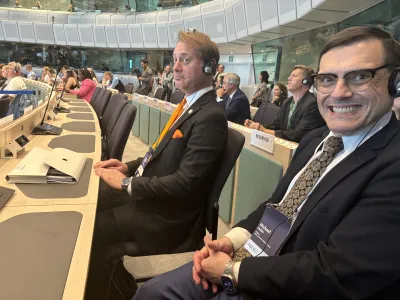
Additional sessions explored the Brussels Parliament's Deliberative Committees, a groundbreaking model that permanently integrates randomly selected citizens into parliamentary deliberations alongside elected representatives—creating more inclusive, cross-partisan policymaking.
Beyond formal sessions, the delegation built relationships with European peers and experts through candid, in-depth conversations about how successful deliberative practices might be adapted to strengthen democratic governance in the United States.
Following the European sessions, IDEA Director Michael Neblo and Amy Lee met with program staff from the Bertelsmann Foundation, Rockefeller Foundation, and the European Parliament Liaison Office to share the trip's outcomes and discuss future collaboration between U.S. and European partners on adopting and expanding democratic innovations, particularly Citizens Assembly and Deliberative Town Hall sequences.
The Deliberative State Governance program will conclude this fall, when the state officials reconvene in the U.S. to observe a local Citizens Assembly and discuss implementation options, potentially including a Deliberative Town Hall component.
