The IDEA Toolkit

Citizens aren’t disengaged because they’re apathetic— it’s because they’re frustrated. The ways elected officials try to engage them are outdated and often counterproductive. Traditional town halls and other engagement methods reward the loudest voices, not the most representative ones. The result: polarization, distrust, and policymaking based on skewed inputs.
The IDEA Toolkit offers a suite of evidence-based models widely used widely by Members of Congress in the US and by elected officials in other countries. These tools can help public officials and our democratic institutions reconnect with constituents and earn their trust, and provide more authentic, informed, and representative input for policymaking.
The Impact of Using These Tools
Because deliberative events recruit a representative cross-section of constituents, they offer lawmakers a chance to reach beyond “the usual suspects.” In fact, they particularly attract citizens who tend not to follow politics or who have become disenchanted with the system. Furthermore, after participating, these citizens became more likely to vote and take part in political discussions.
The design of the deliberative engagements—with participants reviewing non-partisan background materials and neutral, non-partisan facilitation —resulted in high-quality, informed conversations, not talking points or simplistic arguments.
Participating in a deliberative engagement significantly increased citizens’ trust and approval of the participating elected official.
Participants surveyed four months after the deliberative event were 10% more likely to vote for the representative who engaged with them in this way.
The Tools:
Deliberative Town Halls
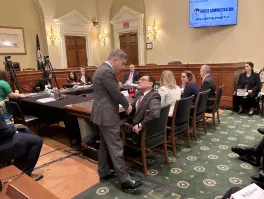
Our flagship innovation, Deliberative Town Halls, is one of the most well-proven models in the world for reconnecting representatives with their constituents. Deliberative Town Halls are designed to rebuild trust between citizens and their representatives, and to provide lawmakers with actionable insights into constituent opinion. They can be used at all stages of the policymaking process: to discover constituent priorities, to provide input on a set of policy options, or to provide feedback and accountability on enacted legislation. They involve a large representative sample of constituents, are typically one hour long, and are conducted online to reduce barriers to participation.
Citizens Assemblies
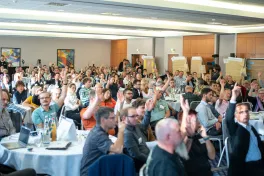
A Citizens’ Assembly is a deliberative process in which a smaller representative cross-section of residents convenes over several sessions to study a question, deliberates together to reach a rough consensus, and develops recommendations for decision-makers to respond to. Citizens' Assemblies are citizen-to-citizen forums, with policymakers participating initially to develop the remit, or scopes and goals of the assembly, and then at the end to respond to the assembly’s recommendations. Widely used throughout Europe at all levels of government, including the EU, they are now being adopted in the US. IDEA senior fellow Marjan Ehsassi and her organization, FIDE-NA, provide training, technical assistance, and evaluation for lawmakers who want to adopt this innovation.