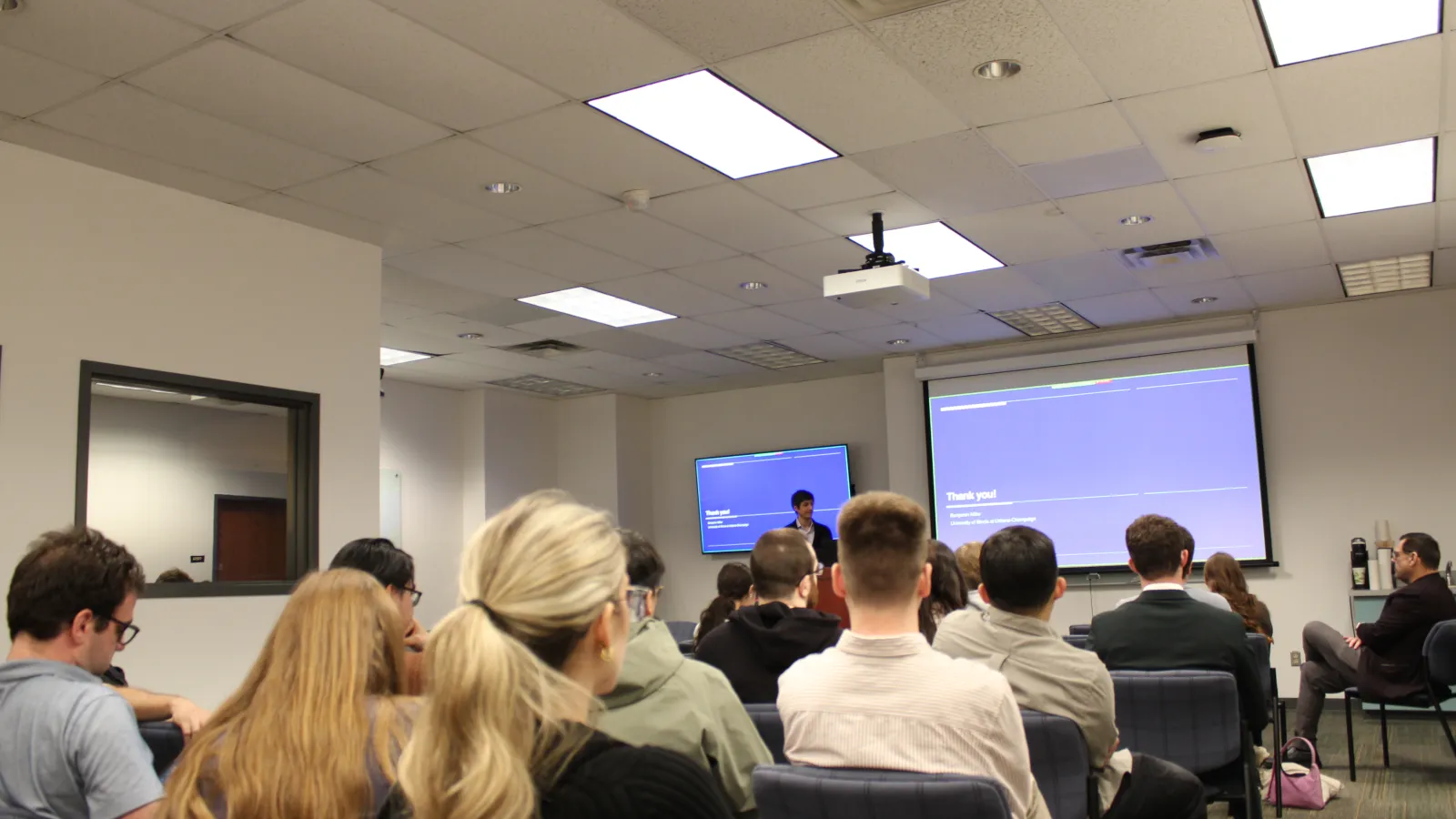
IDEA Hosts Dr. Miller for Talk on Evaluating Democratic Citizens
On March 25, 2026, IDEA welcomed Prof. Benjamin Miller, Assistant Professor of Political Science at the University of Illinois Urbana-Champaign, for the IDEA Speaker Series talk titled "Evaluating Democratic Citizens: A Task-Centered Framework."
Introduced by Dr. Neblo, Dr. Miller presented a new framework for evaluating democratic citizens, describing it as a practical approach that connects political theory with empirical political science.
Miller began by noting that political scientists have evaluated citizens for decades, often labeling them as uninformed, biased, easily influenced, or anti-democratic, without clearly defining good citizenship. His framework addresses this gap by requiring three elements for sound evaluation: a task, an ideal of performance, and suitable data. He emphasized that none of these elements can stand alone.
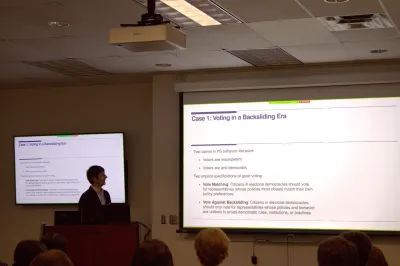
The talk featured two case studies showing the problems that arise when these elements are left implicit. The first focused on voting during democratic backsliding, where Miller identified two conflicting standards in the literature: "vote matching," which suggests citizens should vote for candidates who align with their policy preferences, and "vote against backsliding," which urges citizens to avoid supporting candidates who threaten democratic norms. He noted that these standards are rarely recognized as competing, yet they lead to opposite recommendations for the same voter.
The second case addressed affective polarization. Miller argued that scholars confidently claim affective polarization is harmful to democracy, yet often rely on causal effects that empirical research has not substantiated. He suggested that this concern stems from a deeper, unspoken view of democracy that current literature does not adequately support.
The talk prompted a lively discussion with faculty and graduate students about why empirical scholars hesitate to make evaluative standards explicit, how the framework could be adopted by non-theorists, and the meaning of good citizenship during times of democratic stress.
Dr. Miller is the author of Against Aristotelian Character Education: Practical Wisdom, Flourishing, and Liberal Democracy (Routledge, 2025) and holds a Ph.D. in Philosophy from Stanford University.
Follow IDEA on Instagram at @idea_at_ohiostate and on Facebook at facebook.com/IDEAatOhioState to stay up to date on our events, research, and programming.
To learn more about his work, visit pol.illinois.edu/directory/profile/bm50.